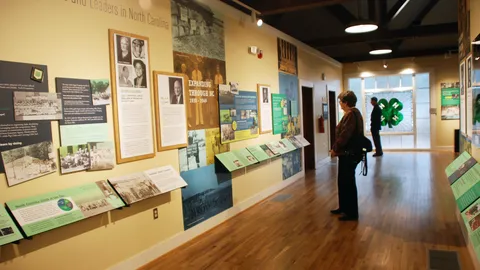
North Carolina 4-H traces its beginnings to 1909, when boys' agricultural clubs, known as Corn Clubs, were established to introduce young people to improved farming practices through hands-on learning. Girls' tomato canning and gardening clubs followed in 1911, helping lay the foundation for what would become North Carolina 4-H.
Over the following decades, the organization expanded beyond its agricultural roots to provide educational opportunities in leadership, citizenship, science, healthy living and other areas.
Today, North Carolina 4-H operates through North Carolina Cooperative Extension, a partnership involving NC State University, N.C. A&T State University and federal, state and local governments. Through programs in all 100 counties and the Qualla Boundary, 4-H provides young people with opportunities to develop skills, build confidence and make a difference in their communities.
Historical Milestones
Explore significant events and developments that have shaped North Carolina 4-H, from its beginnings in 1909 to the present day.
The Early Years (1909–1925)
- 1909 | North Carolina College of Agriculture and Mechanic Arts, now NC State University, signs an agreement with the United States Department of Agriculture to establish boys' agricultural clubs, known as Corn Clubs. Ira O. Schaub becomes the program's first director.
- 1911 | The first girls' tomato canning and gardening clubs are established under the leadership of Jane S. McKimmon.
- 1912 | Corn Club members from Granville County attend a gathering at State College in Raleigh, laying the groundwork for the statewide Short Course that would eventually become North Carolina 4-H Congress.
- 1914 | Agricultural club work for African American boys begins in Sampson County under the leadership of G. W. Herring. The Smith-Lever Act establishes the Cooperative Extension System, providing a national framework for extending land-grant university research to communities.
- 1915 | The first statewide Short Course for white agricultural club members is held at State College in Raleigh, attended by 222 boys and one girl. John D. Wray becomes the first statewide agent for African American boys' agricultural clubs.
- 1919 | The first statewide Home Demonstration (now Family and Consumer Sciences) Short Course for white girls is held at the North Carolina College for Women. The first county 4-H camp is established in Warren County.
- 1920 | The first state officers are elected at the agricultural club Short Course, establishing an early tradition of statewide youth leadership.
- 1924 | The first district Short Courses for African American club members are held in Greensboro and Winton. For the first time, the statewide agricultural and Home Demonstration Short Courses for white boys and girls are held simultaneously.
Establishing North Carolina 4-H (1926–1945)
- 1926 | L. R. Harrill becomes North Carolina's first State 4-H Club Leader, helping bring boys' and girls' clubs under the 4-H name. The first statewide Short Course for African American club members is held at North Carolina A&T College in Greensboro.
- 1927 | North Carolina sends a delegation to the first National 4-H Camp in Washington, D.C.
- 1929 | Boys' and girls' clubs formally unite under the 4-H banner. The first state 4-H camp opens in Swannanoa, and the Health Pageant is introduced at the statewide Short Course.
- 1931 | The North Carolina 4-H Honor Club is established by L. R. Harrill to recognize outstanding members and encourage continued leadership and service.
- 1933 | The statewide 4-H Short Course is canceled because of the Great Depression.
- 1936 | African American 4-H membership reaches approximately 10,000. R. E. Jones becomes the first full-time state leader coordinating 4-H work for African American youth.
- 1939 | 4-H programs for white youth have been established in all 100 North Carolina counties.
- 1942–1945 | Statewide Short Courses are suspended during World War II. North Carolina 4-H members contribute to the war effort through food production, Victory Gardens, scrap metal drives and fundraising for military equipment.
Postwar Growth and Transformation (1946–1965)
- 1946 | North Carolina 4-H membership reaches 100,000. The statewide Short Course resumes under a new name, State 4-H Club Week.
- 1947 | The first North Carolina 4-H Electric Congress is held to promote rural electrification and electrical education.
- 1948 | North Carolina youth begin participating in the International Farm Youth Exchange program. State 4-H Club Week is canceled due to a polio outbreak.
- 1950 | The 4-H Club Foundation of North Carolina is established to raise funds for a statewide camp for African American youth.
- 1952 | North Carolina leads the nation in 4-H membership, with more than 140,000 members, representing approximately seven percent of national membership.
- 1956 | Camp J. W. Mitchell opens at Hammocks Beach in Onslow County as the first state 4-H camp for African American youth.
- 1959 | North Carolina 4-H celebrates its 50th anniversary, with more than 161,000 members in over 2,700 clubs. The 4-H Development Fund is established with the goal of raising $1 million to support camping, scholarships, awards and international exchanges.
- 1963 | L. R. Harrill retires after more than four decades of service, including 37 years as North Carolina's first State 4-H Club Leader.
- 1965 | North Carolina 4-H officially desegregates at the state level, bringing previously separate programs together. Integration of local clubs continues in subsequent years.
A New Era of 4-H (1966–Present)
- 1968 | State 4-H Club Week is renamed State 4-H Congress, continuing the statewide gathering tradition established in 1915.
- 1969 | The North Carolina 4-H Development Fund reaches its original $1 million fundraising goal.
- 1970s–1990s | North Carolina 4-H continues expanding beyond its agricultural roots, strengthening educational opportunities in leadership, citizenship, science and other areas while serving increasingly diverse communities.
- 2006 | 4-H Youth Development and Family and Consumer Sciences are combined into one organizational unit within North Carolina Cooperative Extension.
- 2016 | The Department of Youth, Family and Community Sciences merges with the Department of Agricultural and Extension Education to form the Department of Agricultural and Human Sciences.
North Carolina 4-H History and Learning Center
Located at Millstone 4-H Camp in Ellerbe, the North Carolina 4-H History and Learning Center preserves and shares the people, programs and traditions that have shaped 4-H across the state.